Ballroom Dance Coloring Pages
Every ballroom dance comes from somewhere. One started in the busy cafés of Argentina, another at a school dance where everyone took their shoes off, and one is even named after a city! My husband and I have taken ballroom lessons many times and we're still pretty bad at (and love every minute of) it, so I have huge respect for anyone who can do these steps properly.
Jump to: Smooth | Latin | Swing | More Dancing
Smooth Dances
The smooth dances glide around the room with partners holding each other the whole time.
Waltz
Foxtrot
The foxtrot is named after a person, not a fox. Harry Fox was a performer in New York who danced a trotting step in his shows back in 1914, and soon everybody wanted to learn it.
Quickstep
In the 1920s, dance bands in England started playing the foxtrot faster and faster. Dancers mixed in kicks and hops from the Charleston to keep up, and the quickstep was born. That's why these two look like they've just bounced out of a 1920s party.
Tango
The tango comes from the port cities of Argentina and Uruguay, where people danced it in the streets and cafés. When it reached Paris around 1912, the whole city went tango crazy.
The ballroom tango is grouped with the smooth dances because partners hold each other the whole time and travel around the room, just like in the waltz.
The waltz began as a twirling country dance in Austria, and by the 1800s everyone in Vienna was waltzing. Some grown-ups thought it was shocking! Partners held each other close and spun round and round, which was very daring back then.

Latin Dances
The Latin dances come from Spain and Latin America, and they're full of rhythm you can feel right down to your toes.
Paso Doble
Paso doble means "double step" in Spanish. It's named after the lively march music played in Spanish bullrings as the matadors parade in. The dance pretends to be a bullfight with the woman acting the part of the cape, but there's no bull and (hopefully!) nobody gets hurt, just lots of stamping and intense poses.
Samba
Samba is the dance of Brazil. Every year at Carnival in Rio de Janeiro, samba schools parade through the streets in giant feathered costumes. The music has a bouncy beat with roots in African drumming.
Salsa

Salsa means "sauce" in Spanish, and like a good sauce it's a spicy mix. It grew up in New York in the 1960s and 70s, when musicians from Cuba and Puerto Rico blended their music together.
Swing Dances
The swing dances are the bounciest of all, with kicks, jumps and plenty of big grins.
Charleston
The Charleston is named after a city: Charleston, South Carolina. African American dancers had been doing its swivelling, kicking steps for years before a 1923 song made it famous all over the world. Flappers in short dresses and long beads loved it.
Jive
The jive grew out of swing dancing in the 1930s and 40s. By the 1950s, teens were jiving to rock 'n' roll at school dances called sock hops. They danced in their socks so they wouldn't scuff the gym floor!
More Dancing
Dancing with the Stars
Dancing with the Stars is one of my favourite shows. The realistic dancers on these coloring pages are all dressed up for competition night...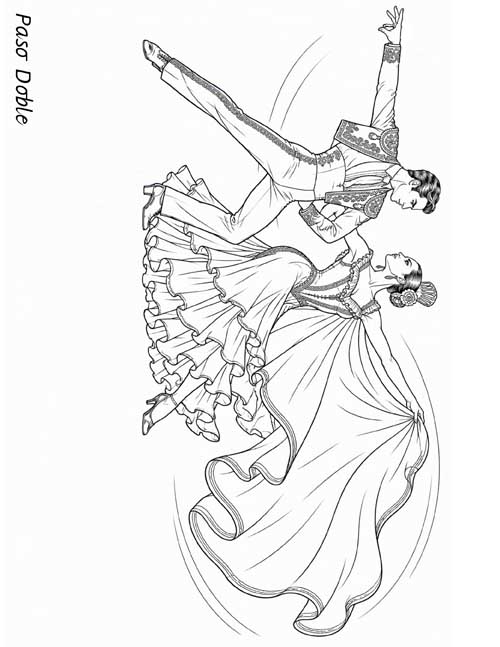
Dancing with the Stars coloring pages
More dancing coloring pages
Flamenco dancers from Spain stamp out a rhythm with their heels while castanets click in their hands. Find them alongside Morris dancers and more...