Greek Underworld Coloring Pages
Welcome to my Greek Underworld coloring pages.
The Underworld was the shadowy realm beneath the earth where the Greeks believed the dead went, and it's older than the gods who ruled it. Hades was its king, but the Underworld has a story of its own, and this page follows that story in order
We start with how the place began, then travel the road every soul took to reach it, visit the three places a soul could end up, and finish with a few visitors who, despite the odds, came back out again!
Jump to: Origin | The Road In | Three Destinations | Visitors Who Came Back
Tap any image to open the full-size printable, then download or print it.
How the Underworld Began
It Was Already There

Before there were gods or heroes, deep inside the newly made Earth, there was a place that stayed dark all the way down.
The Greeks called it Tartarus, and it was one of the very first things to exist, older than the sky and the sea. Nothing and no one had been sent there yet, but it was already deep enough to hold whatever came next.
Darkness and Night

Two powers older than any god appeared early on: Erebus, who was Darkness, and his sister Night. Erebus ruled the hidden world below, where no daylight ever reached, and the realm was named after him and if I'm honest, Darkness was a bit of a boring fellow.
His sister, Nyx, Primordial of Night kept a palace there too. And Nyx. Well, she was the furthest thing from boring. Nyx was mysterious, quiet, and a little dangerous. She didn’t make a fuss. But there’s a reason even the gods tiptoed around her and a reason that they were all eager for her to arrive and desperate for her to go...
The First Prisoners

Uranus was the first ruler of the sky, and that’s a big job that left him short on patience. He and Gaia had plenty of children, including the Titans and some giants with a hundred hands each who never stopped stomping around making earthquakes. Uranus decided he was sick of them, so he threw them into the depths of Tartarus.
Later, Zeus freed the giants to fight on his side in a war against the Titans. The Titans lost and were sent down to Tartarus too, so Uranus’s children ended up on both sides of that war. Their mother, Gaea, was not happy about how any of it started, and she wasn’t the type to sit still...
How Deep It Goes
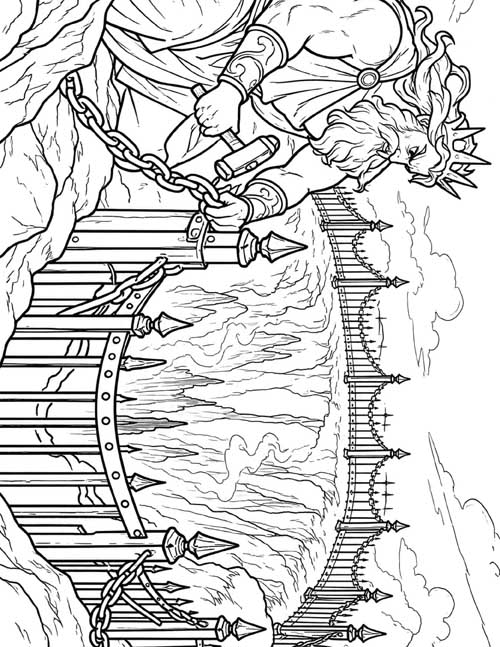
One ancient poem measured Tartarus this way: an anvil dropped from heaven would take nine days and nights to reach the earth, and nine more to reach Tartarus. A bronze fence ringed it, with night spread around it in three layers and the roots of the earth and sea growing overhead. Poseidon attached bronze gates in the wall, and the giants Zeus had freed stood guard.


giant with many arms
(sorry, I can't figure out how to draw 100 arms and 50 heads!)
The Brothers Draw Lots

With the Titans beaten, Zeus and his brothers divided the world by drawing lots. Zeus took the sky and Poseidon took the sea. Hades drew the gloomy regions below the earth and became their ruler.
The House of Hades

The Greeks often called the whole Underworld the "house of Hades," as if the entire kingdom were one enormous, gloomy home. Deep inside it stood his echoing halls, and Cerberus lay at the front door, wagging his tail at newcomers but never letting anyone back out.
A Queen Arrives

One day Persephone was picking flowers in a meadow when the ground opened beside her. Hades rose out of it in a chariot pulled by four black horses and carried her down to his kingdom, where she would become its queen. Zeus had allowed it, and only the sun god and Hecate heard her call out.


The Road In
Death Comes
Every soul's journey began with Thanatos, the spirit of Death. He and his twin brother Hypnos, who was Sleep, were children of Night and lived in the Underworld. People feared Thanatos, yet artists pictured him as a gentle young man with an upside-down torch, one arm around his brother. Hypnos (Sleep) carried poppies and slept in a silent cave where the sun never reached, and the river Lethe began there.


Hermes Leads the Way

Zeus gave Hermes a winged cap and winged sandals and made him the guide of souls, a job Hades had once done himself. The dying called on Hermes to see them safely across the river Styx, and he could also bring spirits back up to the living world.
The Doors
Where was the door? In Homer's Odyssey, the entrance lay at the far western edge of the world, beyond the ocean, in a land of endless mist. Later poets pointed to places like caves, hollows under trees or cracks in the ground ... even an eerie lake in Italy called Avernus, where it was said no bird would fly.
Hecate at the Crossroads

Hecate was an old and generous goddess, known for helping sailors and athletes. She carried a torch and walked with dogs.
Crossroads were hers, and people left her food there at the end of each month.
The Rivers

Five rivers ran through the Underworld, and their names said a lot about them. Acheron meant sorrow and Cocytus meant lamentation. Styx, the sacred one that all souls had to cross eventually, was named for intense darkness and wound around the realm nine times, and Phlegethon ran with flames instead of water. Lethe, the gentlest, flowed in a quiet valley far beyond the others.
The Ferryman and His Coin

Charon, the grim old ferryman, rowed souls across the Styx, but only the ones who'd been buried properly and could pay the fare. The fare was a small coin, placed under the tongue. Souls who arrived without it waited on the bank for a hundred years.
The Gate and the Dog

On the far bank lay Cerberus, a huge dog with three heads (and in some stories snakes bristling along his necks). He guarded the way to the judges' tribunal and he let every soul in and no soul out.
The Judges

Past the dog sat Minos, the chief judge, who listened as each soul told what it had done in life, then decided where it belonged.

Those who'd done wrong were led to the hall of the second judge Rhadamanthus, whose walls stood inside the fiery river Phlegethon, and he named each one's punishment. For the worst of the worst... the fiery river emptied into the ultimate jail of the Underworld... Tartarus.
Three Destinations
We're already heard about the judge of the evil, Rhadamanthus and the path to punishment and redemption (for the lucky who were sent this way) or endless existence in the jail of the Underworld for those weren't so lucky.
The Asphodel Meadows

Most souls ended up in the Asphodel Meadows, a wide, gray, quiet place that was neither a reward nor a punishment. In Homer's time, the Greeks imagined the dead as faint shadows of their old selves. They drifted through the meadows only half aware, thinking about the lives they'd left behind and the pleasures they missed.
The Elysian Fields

The souls who'd lived well first passed the palace of Hades and Persephone, who greeted them kindly. Then they stepped through the gates into the Elysian Fields, where the air was soft and fragrant, and brooks rippled through meadows full of flowers while birds sang in the groves. Everyone found what they'd loved best in life, so the musician found a lyre and the hunter found a bow.
Lethe, the River of Forgetting
In a hidden valley of Elysium flowed Lethe, a silent stream whose water washed away every care and memory. It began in the cave of Sleep, and it was every bit as quiet. Some Greeks believed that after a thousand years in Elysium, souls drank from it and returned to earth to live new lives, with no memory of the old ones.
Tartarus and the Furies
After Rhadamanthus named a soul's punishment, the Furies led it to the great gate of Tartarus, the bronze gate Poseidon had fixed long ago. These winged goddesses had snakes twined in their hair and stood for the guilt and remorse that follow wrongdoing. Later Greeks saw them as stern but fair, since they helped keep the world in order. Beyond the gate lay the deep place where the Titans were still kept.
The Famous Punishments
A few prisoners of Tartarus became famous for their punishments. Tantalus, a king who'd betrayed the gods' trust, stood in water up to his chin, but it drew back whenever he bent to drink, and the fruit hanging above him swung out of reach. Ixion, who'd taken advantage of the gods' hospitality, was bound to a wheel that never stopped turning. Sisyphus, who'd once chained up Death himself, pushed a huge boulder up a hill, and it rolled back down every time.
Visitors Who Came Back
Orpheus
The musician Orpheus lost his wife Eurydice to a snakebite and went down into the Underworld with only his golden lyre. His music was so beautiful that the boulder stopped rolling and the wheel stood still. Hades and Persephone were moved and agreed to let Eurydice go, as long as Orpheus didn't look back until they reached the upper world. He nearly made it, but looked back just before the end, and she vanished.
Herakles

The last and hardest labor of Herakles was to bring back Cerberus. Hades agreed, but only if Herakles used no weapons. He found the dog by the river Acheron, held on through all the barking and a bite from its snake tail, and led it up to the world above.
Psyche

Aphrodite sent Psyche into the Underworld to fetch a box of beauty from Persephone. A voice told her what to pack: a coin for Charon and a cake for Cerberus. She turned down every feast and followed every rule except the last, which was to leave the box closed.
Odysseus

On his way home from Troy, Odysseus sailed to the edge of the world to speak with the blind prophet Tiresias. The spirits of the dead gathered around him, including his mother and the heroes of the war. Achilles told him he'd rather be the poorest farmhand alive than rule over all the dead.